The Book:
Presence With Trauma
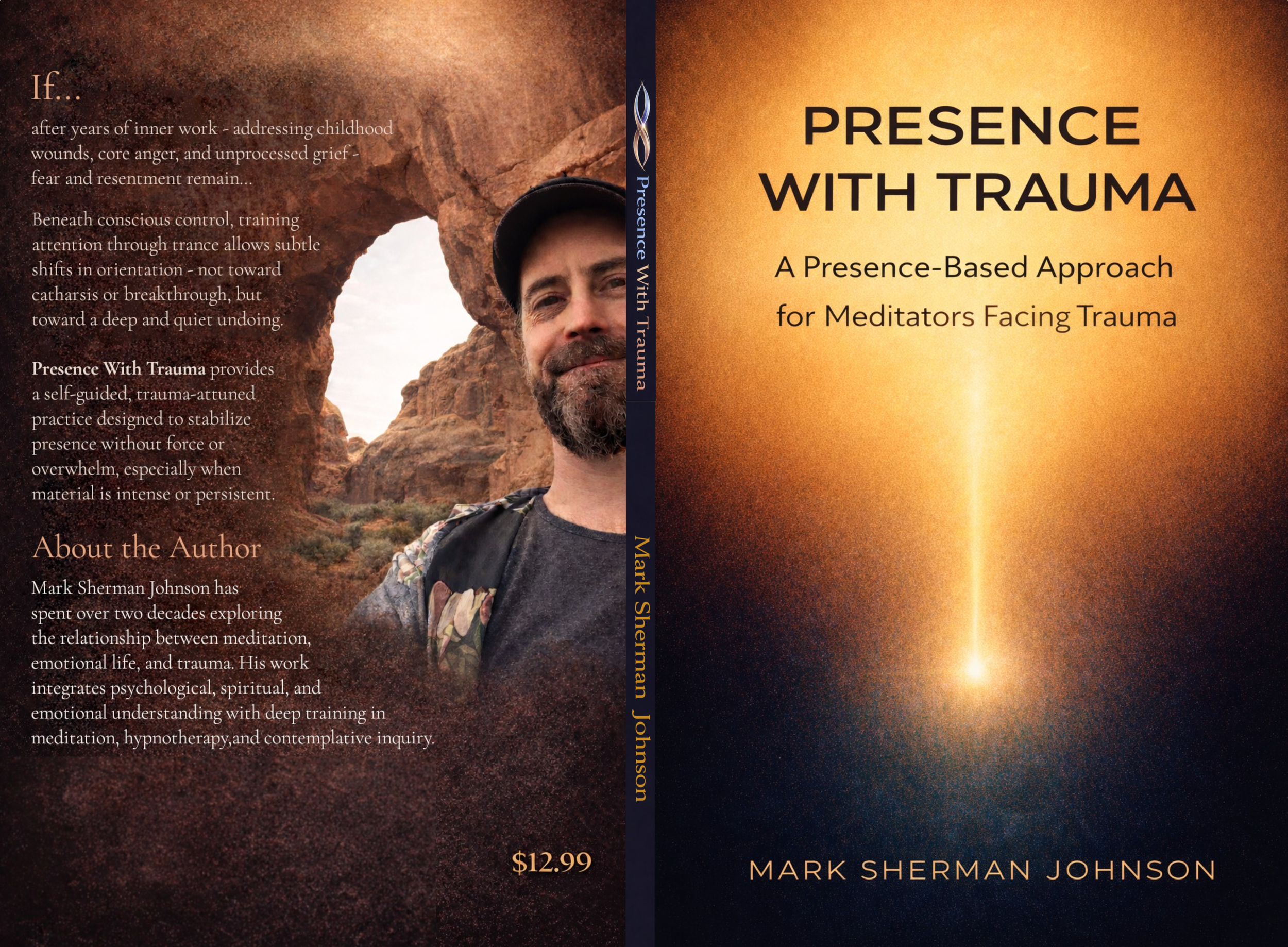
Presence With Trauma illustrates a self-guided, trauma-attuned practice designed to stabilize presence without force or overwhelm.
The Conclusion of the book is posted below.
Read online, or get the pdf file (no charge).
Enter your email to access instantly
Presence With Trauma
Chapter 24Conclusion
When every option is a bad one, when the imp on your shoulder is loud and certain and the whole of you says move, fix it, fight, run, that moment is the trap. That is the Gap. The first rule is this: do not act from within the Gap.
It is not a moral rule, and we do break it all the time. That is allowed. But if we wish for the Gaps to dissolve in time: indecide.
Hold to the razor's edge. Keep the question open. Let the unconscious mind work in our service. This wisdom is not new. Just largely forgotten.
Five hundred years ago a Basque soldier named Íñigo of Loyola took a cannonball to the leg at the Siege of Pamplona in northern Spain and was carried home to mend. Laid up with nothing to do, he watched his own mind recounting his glory days, and read books about the saints, which were the only books in the house. Both made him feel good, but after the reminiscing he would feel down, and after reading of the saints his heart stayed elevated.
He came to understand that each of us is always in one of two states, what he called desolation or consolation. We are either connected or separate. And by discerning which, we may act accordingly.
What he called desolation, we have been calling the Gap.
He developed fourteen rules of discernment, which simplify as follows. When in desolation, take no action, make no decision, be patient, and remember consolation. And when in consolation, enjoy it but do not grasp. Be humble, for we did not cause it. And remember desolation.
These are rules for discerning what he called spirits, which we might call forces, or parts, and he meant them to bring us closer to God. Íñigo lived another thirty years and founded the Society of Jesus, the Jesuits, and his rules of discernment lived on inside its training manual, the Spiritual Exercises. Now he is remembered as Saint Ignatius of Loyola.
We borrow his rules whole cloth and apply them in this framework of presence with trauma, not as an approach to God, but as an approach to presence. And not for the sake of a self landing in consolation, but for the dissolution of the self into the conscious forces of presence.
Ignatius did not have our modern understanding of presence, somatics, trauma, psychology, and the breadth of the world's spiritual traditions. And today we lack his understanding of desolation, which means apart from the one, and his counsel: in desolation, make no change. Do not act. Do not decide. Hold, and wait for the light, and only then move.
Today our trauma therapies, our meditations, our self-help routinely violate this first rule. With discernment, we can stop paying the cost of that error. Decide from inside the trap and you take the thin, frightened sketch the Idios handed you and make it final. The sketch is the trap. Refuse, and the Idios cannot close on the thin picture, so it goes back to its study and composes you a truer one. The dark is where the picture is thinnest, and a decision made there fixes the thinness in place.
But the opportunity is greater still. Ignatius did not see the Idios: this aspect of the unconscious mind that presents our experience to us and observes our response. Without seeing it as separate from us, we are bound to its Imago, the presentation it offers.
Ignatius could only wait out the desolation, holding still until the light returned on its own. We can do more. From consolation. The Idios minds the Gap now, while our awareness may rest elsewhere. The conscious mind does not have to go down into the desolation. It should not. That work is owned by the Idios.
So consider all that Part I: Outside and Part II: Inside placed in your hands, and how much of it is here, inside the desolation, without breaking the first rule.
The breath comes comfortable, filling the whole body. The eyes soften and release their shock. The lucent spaces open, and we rest in them. The space around us is there to be entered, as is the space of the heart, and the space of the mind. We are even allowed to enjoy this.
All of it, while the Idios makes no decision and desolation is fully allowed.
Desolation happens. But suffering is optional.
So here is the whole of it, small enough to carry. When you are in the dark, do not act from the dark. Hold the question open, and let the small god behind the curtain go back to its study and build you a world with room to move in. And do so in a way that is true, good, and beautiful.
Our conscious awareness of desolation is a dream to wake up from, so may our conscious awareness of the Gap be kind, growing ever quicker, directing the Idios skillfully and efficiently.
Imagine pretending desolation, just to focus the attention of the Idios, so as not to repress. But then your work, conscious reader, is to imagine pretending what could be.
And know that when we witness desolation, the seeds of consolation are already sown, and growing. If there are parts of us that are outside of the desolation, and there almost always are, from there we may breathe comfortably, with no waiting required.
The Stoics counseled us to place our attention only on what we can affect. The past is out of our control, and so not our truest interest. We need not fix on the future either, but discover instead that we are the living presence, and open into it.
Dorothy woke in her own gray bed and found she had held the way home the whole time. The wizard had shown her nothing she did not already carry. Presence is like that. It was never somewhere else, and never something to earn. It was the ground beneath the whole performance, waiting behind the veil, needing only to be met directly and known for what it is.
You have held it all along.